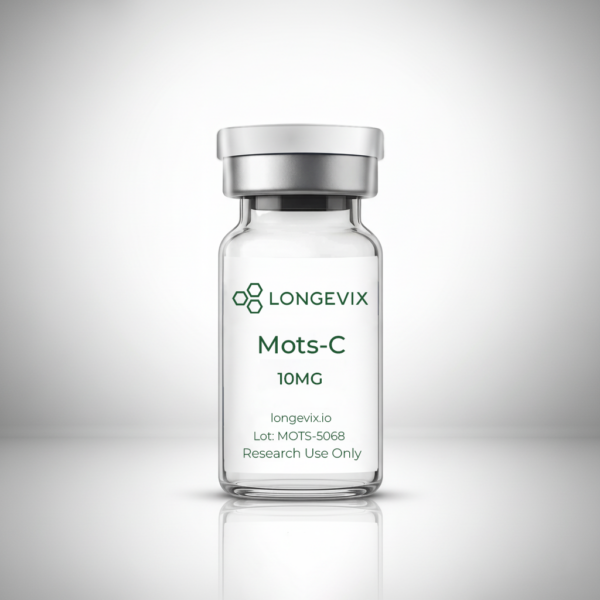
Description
Advanced Scientific Overview of MOTS-c — The Mitochondrial Peptide Redefining Energy, Fat Loss & Longevity
MOTS-c stands at the forefront of next-generation metabolic research. As a mitochondrial-derived peptide (MDP), MOTS-c doesn’t operate like conventional peptides — it rewires how cells manage energy, adapt to stress, and regulate age-related metabolic decline. Encoded directly within mitochondrial DNA, this 16-amino-acid peptide plays a central role in fat oxidation, glucose management, endurance capacity, and cellular resilience, making it one of the most compelling peptides in advanced longevity and metabolic research.
Researchers turn to MOTS-c for its ability to influence multiple high-value pathways tied to fat loss, exercise performance, mitochondrial function, and overall metabolic health.
Key Research Applications of MOTS-c
• Enhanced Fat Oxidation – Supports mitochondrial efficiency and promotes cleaner, more efficient utilization of stored fat.
• Elevated Energy & Endurance – Improves exercise capacity and muscular performance in experimental models.
• Improved Glucose Regulation – Enhances insulin sensitivity and metabolic flexibility.
• AMPK Activation – Engages the same cellular pathways triggered by fasting, caloric restriction, or high-intensity training.
• Anti-Aging Support – Helps counter metabolic slowdown, muscle loss, and oxidative stress associated with aging.
MOTS-c has emerged as a powerful mitochondrial signaling molecule in research settings focused on metabolism, performance, and cellular longevity.
Scientific Overview & Mechanism of Action
MOTS-c (Mitochondrial Open Reading Frame of the 12S rRNA type-c) is uniquely encoded inside the mitochondrial genome — something extremely rare in peptide biology. This mitochondrial origin gives MOTS-c a distinctive regulatory role: it acts as a metabolic messenger that communicates directly with the cell nucleus to maintain balance in energy production, stress adaptation, and age-related metabolic function.
Mechanisms of Action
AMPK Activation
One of MOTS-c’s most studied effects is the robust activation of AMPK — the master energy sensor responsible for:
This makes MOTS-c a potent metabolic regulator in research involving endurance, fat loss, and insulin response.
Mitochondrial–Nuclear Crosstalk
Acts as a molecular “switch,” coordinating mitochondrial and nuclear communication to reduce oxidative stress, optimize ATP production, and stabilize metabolic output.
Insulin Sensitivity & Glucose Uptake
Promotes glucose transport into skeletal muscle and improves insulin response, even in high-fat-diet research models.
Exercise-Mimetic Effects
Simulates cellular adaptations associated with physical activity — boosting endurance, muscle efficiency, and metabolic rate without mechanical exercise input.
Pharmacology & Pharmacokinetics
-
Administration: Primarily evaluated via subcutaneous injection in research environments.
-
Distribution: Rapid uptake observed in skeletal muscle, adipose tissue, and metabolically active organs.
-
Cellular Penetration: Demonstrates the ability to move into the nucleus and regulate gene expression tied to metabolism.
Its mitochondrial origin may contribute to its uniquely stable activity profile in preclinical models.
Clinical & Preclinical Research Findings
Fat Loss & Metabolism
In rodent studies, MOTS-c significantly reduced body weight and visceral fat mass — even when caloric intake remained unchanged.
Physical Performance
Mice receiving MOTS-c exhibited up to double the endurance capacity, suggesting substantial enhancement in muscle efficiency and fatigue resistance.
Anti-Aging Potential
Older mice treated with MOTS-c retained youthful metabolic signatures, higher activity levels, better muscle integrity, and improved resilience against age-related decline.
Glucose Regulation
Improved glucose tolerance and insulin sensitivity have been demonstrated independent of dietary input — a major area of interest for metabolic and longevity research.
Early Human Data
Preliminary human findings indicate favorable safety, improved exercise tolerance, and meaningful support for metabolic markers associated with mitochondrial health.
Safety Profile
Preclinical research highlights:
-
High overall safety margin
-
No significant toxicological findings at studied doses
-
No activation of growth pathways
-
Favorable profile for long-term metabolic and aging studies
This positions MOTS-c as a promising research candidate for studies focused on age-related metabolic decline, endurance, and cellular stress resistance.
Regulatory Status
MOTS-c is currently classified for research and investigational use. It is not FDA-approved for human or veterinary applications. However, due to its mitochondrial origin and broad influence on metabolic health, MOTS-c remains a leading candidate in ongoing research surrounding obesity, type 2 diabetes, sarcopenia, exercise performance, and longevity science.